

How to show up on a bad day
#6: When motivation's gone, don't rely on willpower. Lower the friction until the first step is seconds away.


Yesterday I almost didn’t publish.
Didn’t feel well.
Felt kind of all over the place.
My mind was racing with thoughts and the last thing I wanted to do was sit down to write.
On the other hand I didn’t want to post a zero because I knew how it would make me feel.
With the last bit of energy I had I decided to do the smallest thing closest to writing a post—go through my notes and try to make something out of it at least.
I guess I was hoping for some eureka moment or a miracle.
But one thing led to another and from just looking through notes I started scribbling. Scribble to scribble and the final result?
I managed to publish my fifth Substack post in a row. It felt chaotic. It felt “unfinished” and “rough”—but it was there, out in the open.
I thought I didn’t do a good job. Then a comment popped up that made my day:
“This was an intriguing article. The idea seems good to try. I will try it tomorrow morning. Thank you for this idea.”
So today, I want to tell you about the little trick I played on myself—how it got me to do the thing even when it was the last thing I wanted to do.
Let’s start with a question
What do going to the gym and writing have in common?
Both only pay off if you keep showing up. And both are hardest to show up for on exactly the days you don’t feel like it.
When you’re starting out, missing one day is easy. The next day it’s easier still. Miss a third and the excuses compound—and we both know what happens next. You give up, and feel like a failure.
So here’s the exact deal I made with myself that day:
“OK, if you’re not writing, at least open your notebook, read through the notes, and do something related to writing so the day isn’t a complete loss.”
So I opened my notebook and started flipping through the pages. Then I took a piece of paper and started scribbling. From scribble to scribble, more scribbling—and something started to happen.
Like that Swahili proverb—little by little, a little becomes a lot—I managed to publish.
Say what?
What just happened?
I somehow managed to trick myself into writing a post. How did I do that? And what if I could learn to do it on purpose—so next time I don’t feel like it, I do the thing anyway and spare myself the failure and the guilt?
I had to talk to someone about it—and as usual, my buddy Claude was there for me.
So I quickly Wispr Flowed it (aka dictated) and learned a few things that’ll help you trick your brain into doing your thing next time—even when you don’t feel like it.
I genuinely think my brain reached for this because I’d been through a similar experiment before—with working out and losing weight.
Once you understand the concepts and can see what’s happening, you can pull through—from hesitation to action. Which brings us to the first one.
Activation energy (from chemistry to behaviour)
In chemistry, activation energy is the minimum energy needed to start a reaction. Once it begins, it often continues with much less effort.1
In everyday behaviour, it maps cleanly:
Starting a new task has a high energy cost.
Continuing one has a much lower cost.
Once you’re moving, you’re in it—you go with the flow.
The accidental setup yesterday helped me more than I realised. My notebook, my loose notes, and my laptop were all sitting on the kitchen table.
I walked past that table all day—breakfast, lunch, coffee, and every “romantic walk” to the fridge to snack on something. Each time, I passed the laptop and the notes, and each time it nudged me to think about my Substack.
Those few steps didn’t just save seconds—they removed the decision.
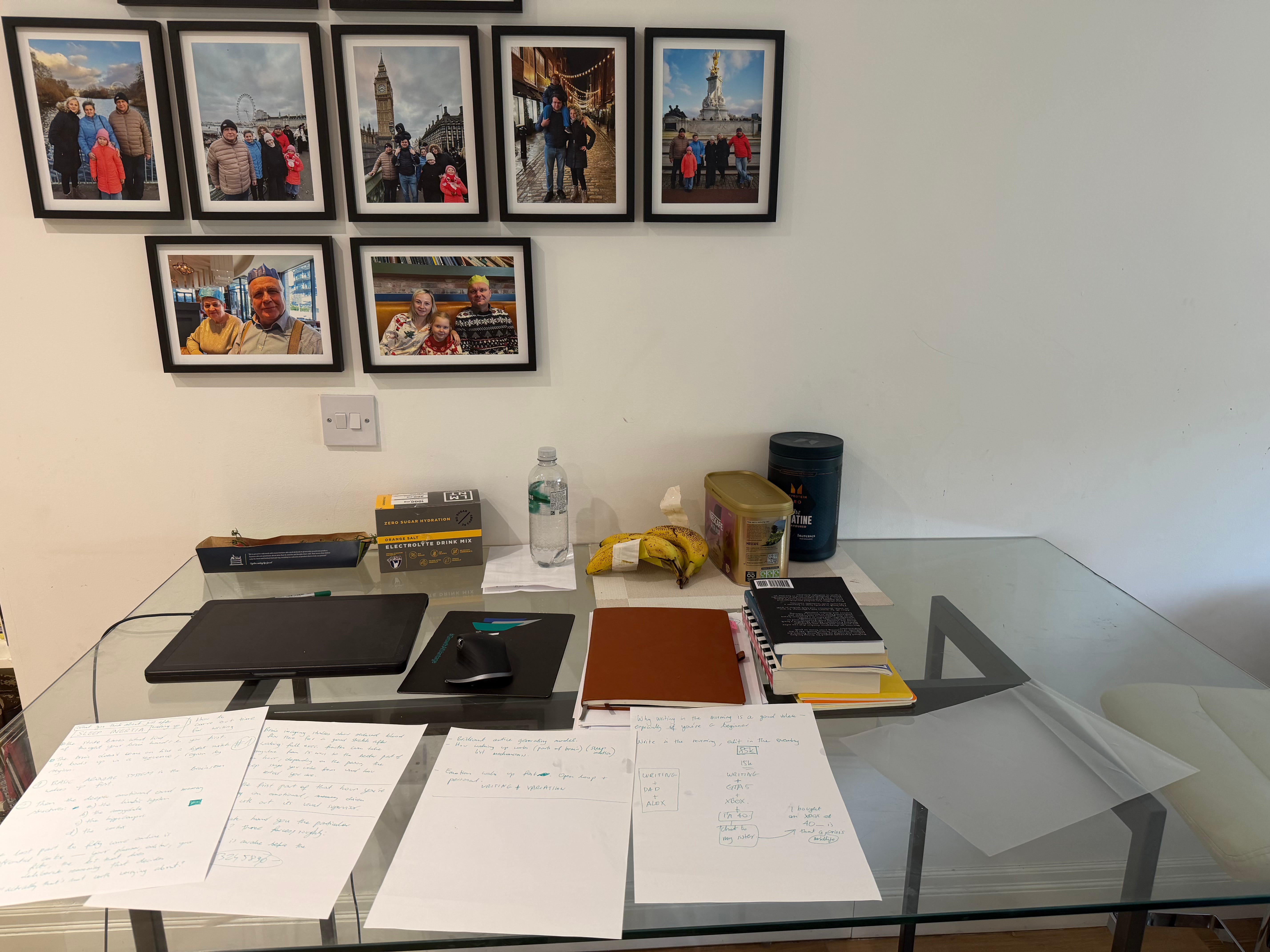
That’s why trivial setup changes matter so much.
Shawn Achor calls it the 20-second rule.2When he wanted to practise guitar daily, the guitar lived in a cupboard—and he almost never played. So he moved it onto a stand in the middle of the room. That’s it. Now it was only a few seconds easier to reach. But those few seconds were the whole game: the guitar was right there, in his eyeline, asking to be picked up. Practice went from a decision to a default.
And it cuts both ways. Make a good habit 20 seconds easier to start and you’ll do it more. Make a bad habit 20 seconds harder—remote batteries in a drawer in another room—and you’ll do it less. Achor’s point: we overestimate willpower and underestimate friction. We don’t fail because we’re weak. We fail because the thing was 20 seconds too far away.
So my accidental writing setup makes sense:
Laptop = hidden, needs setup, invites distraction → high activation energy
Notes = visible, immediate, low-stakes → low activation energy
I’ll be leaving my laptop out every day now—both as a reminder of the 100-day commitment and to make it dead easy to just sit down and start.
First takeaway: if you’re committed to something, design your environment to do two jobs:
Remind you of the thing you’re meant to do.
Make starting easy.
Not writing but planning to run every morning? Lay your shoes and kit out the night before, so the first thing you see when you open your eyes is a nudge to drag yourself out the door.
The less energy it costs to get going, the better your odds you won’t talk yourself out of it. Act fast—because otherwise your brain will offer you an excuse or something comfier to do.
Make the first step so small and so close you can take it before your brain wakes up to argue. James Clear calls this making it easy—and his two-minute rule says to scale any new habit down to something you can do in two minutes, so starting is never the obstacle.3
Commit to the gateway, not the goal
This is the reframing trick I played on myself without realising.
Instead of shrinking the goal (”write 200 words”), I changed the entry point entirely: “just sit down and read my notes.”
The key idea:
Goals trigger resistance—they imply effort, evaluation, and the chance of failure.
Gateways feel neutral. Non-threatening.
“Write an article” set off a whole alarm system in my head:
effort—”this’ll take ages”
identity pressure—”it should be good, I don’t want to ship something crap”
ambiguity—”where do I even start? I felt rough, my mind was racing, and I had no plan—just rough notes”
“Open the notebook and read one line” sets off none of that.
So instead of negotiating with the resistance, I sidestepped it.
What’s subtle is that I didn’t make writing feel easier—I started something other than writing. I sat with my notes. But once I was in, momentum carried me forward anyway.
Goal: “Go for a run.”
Gateway: “Put on trainers and step outside.”
You’re not committing to the whole behaviour—just crossing the threshold. Shrinking the distance between doing nothing and doing the thing.
Action creates motivation (behavioural activation)
This flips the usual intuition.
Most of my life I assumed motivation led to action. But it often runs the other way:
action → momentum → motivation
Behavioural activation—a technique from cognitive behavioural therapy for low mood—is built on exactly this:4
A small action can shift mood and energy.
Waiting for the “right feeling” usually leads to paralysis.
And yesterday, at the plain thought of writing, I felt paralysed. Couldn’t act. The friction was too high.
Why going through my notes worked:
The action gave me feedback—progress, clarity, a small reward.
That feedback cut the uncertainty and made me willing to keep going.
It was like my heart texted my brain: this isn’t as bad as you thought.
You don’t feel like writing → you write one sentence → it’s tolerable → you write another → now you’re engaged. Huh. Not so bad. Why not keep going?
The lesson: motivation is usually a consequence, not a prerequisite. Trick yourself into starting—or just kick yourself into it—and the wanting catches up. Once you’re moving, you’re golden.
The 5–4–3–2–1 rule (interrupting autopilot)
I didn’t use this one yesterday—but I love Mel Robbins, I read her book years ago, and I’ve used this method plenty (giving up cigarettes, for one). It works like a charm.
Mel Robbins’ technique is less about motivation and more about interruption.5
Here’s the problem it solves. The moment you think “I should do this,” a tiny window opens—and your brain races to fill it with a reason not to. Maybe in a minute. Let me just check one thing first. I’ll do it after coffee. That’s not laziness, it’s a loop: cue → hesitation → excuse → avoidance. Left alone, it completes every time.
The countdown hijacks it. Counting 5–4–3–2–1 does three things at once:
It forces conscious attention—you can’t count backwards on autopilot, so it pulls you out of the loop.
It starts a clock—a short, finite window that ends in action.
It beats the saboteur to the punch—you move before your brain finishes building the excuse.
Robbins frames it as a launch. Hit zero and you go, like a rocket—no debate. A manual override for hesitation.
I’ve used it for years. It’s how I stopped reaching for a cigarette: 5–4–3–2–1, and I’d put my hands to something else before the craving could talk me round.
The four, side by side
So you can think of the four like this:
Activation energy = the barrier
Gateway = the entry point
Action-first = the engine
Countdown = the ignition switch
Putting it together
Say you want to write consistently:
Lower activation energy: keep a notebook open on your desk, laptop somewhere visible.
Use a gateway: don’t “write”—”just open the notebook and read one line.”
Act first: write one sentence without waiting to feel ready.
Use 5–4–3–2–1 when you hesitate—break the stall, go straight into the damn sentence.
Each move beats a different failure point. I put all four on one page you can save to your phone—pull it up on the days your head is fighting you.
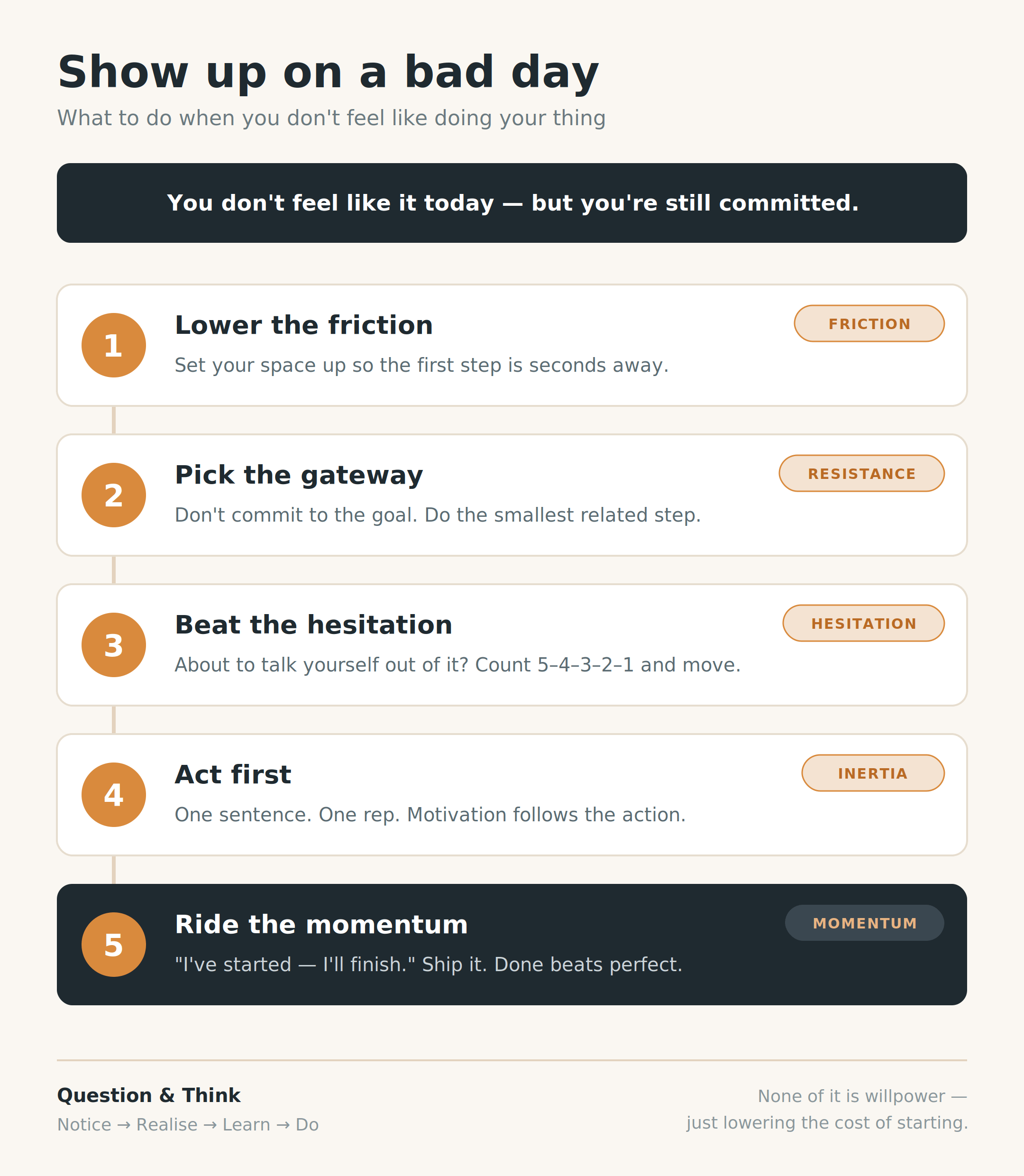
That’s the whole method. None of it is willpower. It’s just lowering the cost of starting until starting becomes the easy choice.
Remember the rough post I almost binned? A stranger read it and said they’d try the idea the next morning. I nearly gave them nothing to read.
So on the days you don’t feel it—don’t aim for a good day. Aim for the smallest thing that gets you moving. Open the notebook. Count 5–4–3–2–1. Ship it.
You never know. It might make someone’s day. It might even make yours.
Take it easy and do your thing,
Jack
References
Activation energy—standard chemistry concept; the behavioural analogy is widely used in habit and behaviour-change writing.
Shawn Achor, The Happiness Advantage (Crown Business, 2010)—the 20-second rule and the guitar example.
James Clear, Atomic Habits (Avery, 2018)—“make it easy” (the third law) and the two-minute rule.
Behavioural activation—a technique from cognitive behavioural therapy for low mood, originating in the clinical depression literature (Peter Lewinsohn, 1970s; later developed by Neil Jacobson and colleagues).
Mel Robbins, The 5 Second Rule (Savio Republic, 2017)—the 5–4–3–2–1 countdown.