

How to plan your Substack post fast—and organise your writing
#7: Four clear steps any beginner can follow and make their own.


The reason most people quit writing online isn’t because they lack clever ideas.
They do know what to write about. The problem is they start each post from zero—a blank page, day after day—and that’s not sustainable. It breaks you. You get lost in the complexity, drowning in your own thoughts, because as a beginner you don’t have a writing process to hold on to.
And that was pretty much me yesterday.
My internal voice was screaming.
After a day at work and a visit to the hospital with my son, my internal state was chaos. Racing thoughts. My mind was going to every topic under the sun but not to writing.
I was staring at the page like a student staring at their teacher when they don’t know the answer to a tricky question. Just me. A blank screen. A pile of messy notes. Stuck.
Time was ticking. It was already close to 5pm I didn’t even start, and at 8pm. I was supposed to take my son to bed. And the more desperately I tried to force myself to write, the more my brain just shut down.
Then today, the same thing again
On post #7—an even busier day—it was me and a blank page again.
Internal chaos. Hundreds of mixed feelings. I’m starting from scratch, fighting myself and the blank screen, the clock ticking. And it’s not the lack of an idea—it’s the effort of starting from zero. Again. After a full day’s work, it was just too much.
The result?
I end up with a post that sounds rushed. The text doesn’t flow, and I can always feel it when I re-read it the next morning.
I feel like a dog chasing its own tail, and it takes a lot of brainpower and effort to straighten the whole thing and shape it into a post with arms and legs.
So I stopped and asked myself a question
How the hell do established creators do this every day? Because there’s no way they work like I do—start from scratch with a chaotic mess, then tighten it, break it into pieces, and put it back together again. It would be unbearable—like assembling furniture with no instructions and half the screws missing.
There has to be an organised way of doing it. Some surgical operation. Planned in advance, then carried out fast. A tactical centre where you plan the writing operation, breach the door, execute the plan surgically, and leave.
And that’s what a writing system is. A frame that holds the finished piece—simple and intuitive enough that you don’t need a manual to use it. Something I set up before I write a word. Then I just fill in the blanks, segment by segment—and once it’s down, I can shape it: rhythm, flow, logic—instead of lurching back and forth like a mad scientist who’s lost a screw in his own lab.
So for a moment I dropped writing, took out a piece of paper, and retraced my thinking process—breaking it into parts, separating it into core segments, then putting it together into a fixed plan I’ll now use for my posts.
A post used to cost me three hours and leave me wrung out. The sketch takes five minutes.
I hate to admit it—because the internet is already full of clever frameworks—but I think I’ve just built my own little one. It’s built around the way I think, because the moment I start writing, I get lost. So the whole purpose of it is to keep me in lane, the way a sprinter has a track. Stay in the lane. Don’t drift left, don’t drift right. Just run the line.
Follow the plan. Don’t lose yourself in some uncontrolled ramble. See how your readers react—and maybe, as your writing evolves, the structure changes with it.
And if you’re a similar writing nutter who battles chaos, racing thoughts and distraction, and hits a wall against the blank page every day—I feel you, and this is for you.
Let me walk you through it—what each part is, why it’s there, and how you can run it yourself. A fair warning: I built this for me. It’s still a thesis. I’m testing it, and I’ll change it. But it sticks in my head easily, because I didn’t invent it—I just retraced the path my own thinking already takes and gave each step a name I’d remember.
The general idea
Every post takes the reader on a short journey. It starts with something I noticed—a problem, or just something useful that caught my attention—and ends somewhere they can actually use. I want every post to be worth the reader’s time, in a real, practical way. The first couple of sentences bring them in. Then four stages carry us through it together. I call them Notice, Realise, Learn, Do.
HOOK (the invitation)
The first sentence your reader meets. Two sentences, max.
You don’t open with a clever idea. You name a pain or a friction so clearly that the reader thinks “that’s me.” That’s all the hook does—it offers them a reason to come and look. It’s not one of the four stages. It just opens the way in.
NOTICE (you noticed something)
You don’t need a smart idea to begin. You just need something you noticed.
Something that grabbed you. A friction, a problem, a thing that annoyed you or even made you furious—yours or somebody else’s. Something you saw and identified with, that felt worth digging into. That’s the bar. Not “be original.” Just “what caught me?”
REALISE (you start digging)
You don’t leave what you noticed sitting on the surface. You follow your curiosity and look under the bonnet.
And once you’re under there, you realise there’s more to it than you first thought. So you keep digging—connecting things, going down, trying to get to the bottom of it.
LEARN (what the digging turns up)
The digging turns up things. Underlying concepts. Universal truths. The real reasons behind what you noticed.
This is where you lay those out—the dots you connected, the principles you uncovered. The stuff that’s true beyond your own situation. This is where the reader actually learns something.
DO (what you do with it)
This is the most concrete part of the post.
The learning handed the reader the concepts. Now you tie them into something they can actually use—a step, a method, a thing to apply in their own life tomorrow. Not “go and reflect.” A real takeaway they can copy and run themselves. You take everything you learned together and turn it into the answer—the solution to the problem you opened with. I believe that a good post is experienced. It means it leaves the reader with something practical.
Why this order isn’t random
Here’s the part that surprised me. When I dug into it, I found my four steps weren’t really invented. They were borrowed—from the way curiosity works in the brain.
Back in 1994, a psychologist called George Loewenstein described curiosity as an information gap: the space between what you know and what you want to know.1
Curiosity, he said, is what you feel when you become aware of a gap that could be filled. And the trigger is small—a little bit of information acts like a priming dose that sharply sparks the urge to know more.
That’s NOTICE and REALISE. You spot something, a tiny crack opens— wait, there’s more here—and it pulls you in.
Then the digging takes over. Researchers at UC Davis found that curiosity recruits the brain’s reward system, and that the link between that reward system and the hippocampus puts the brain into a state where it learns more and remembers more.2
In their study, curious people not only recalled what they were curious about—they also better remembered unrelated things they happened to see while in that curious state.
That’s LEARN. The digging doesn’t just feel good. It’s the state where what you find actually sticks.
So notice → realise → learn is the path your brain already takes when something grabs it: a gap opens, curiosity fires, you dig, and what you find gets locked in. I didn’t design it. I just gave it names and learned to write on top of it.
The brain hands you those first three for free. DO is the part I bolted on—because a post that doesn’t end in something you can use is just entertainment or what James Clear calls a “what-to post”. I want my posts to be “how to actionable posts.”
And honestly, it’s just how I work anything out: something nags me, I dig, I find the thing, I use it.
So here’s how you actually use it
Before you write a single paragraph, write one sentence for each section—just one. One line for your hook, one for NOTICE, one for REALISE, one for LEARN, one for DO. That’s your sketch. Five sentences, and the whole post is mapped before you’ve started.
Then write the post. And every time you feel yourself drifting—wondering what comes next, rambling, going back and forth—you look at the one sentence for the section you’re in, and it pulls you back into lane. That sentence is your track. You stay on it.
That’s the whole trick. You’re not holding the entire post in your head anymore. You’re holding one sentence at a time.
And to show you it works, here’s the exact sketch behind the post you’ve just read—five sentences, one per section. This is what the template looks like filled in:
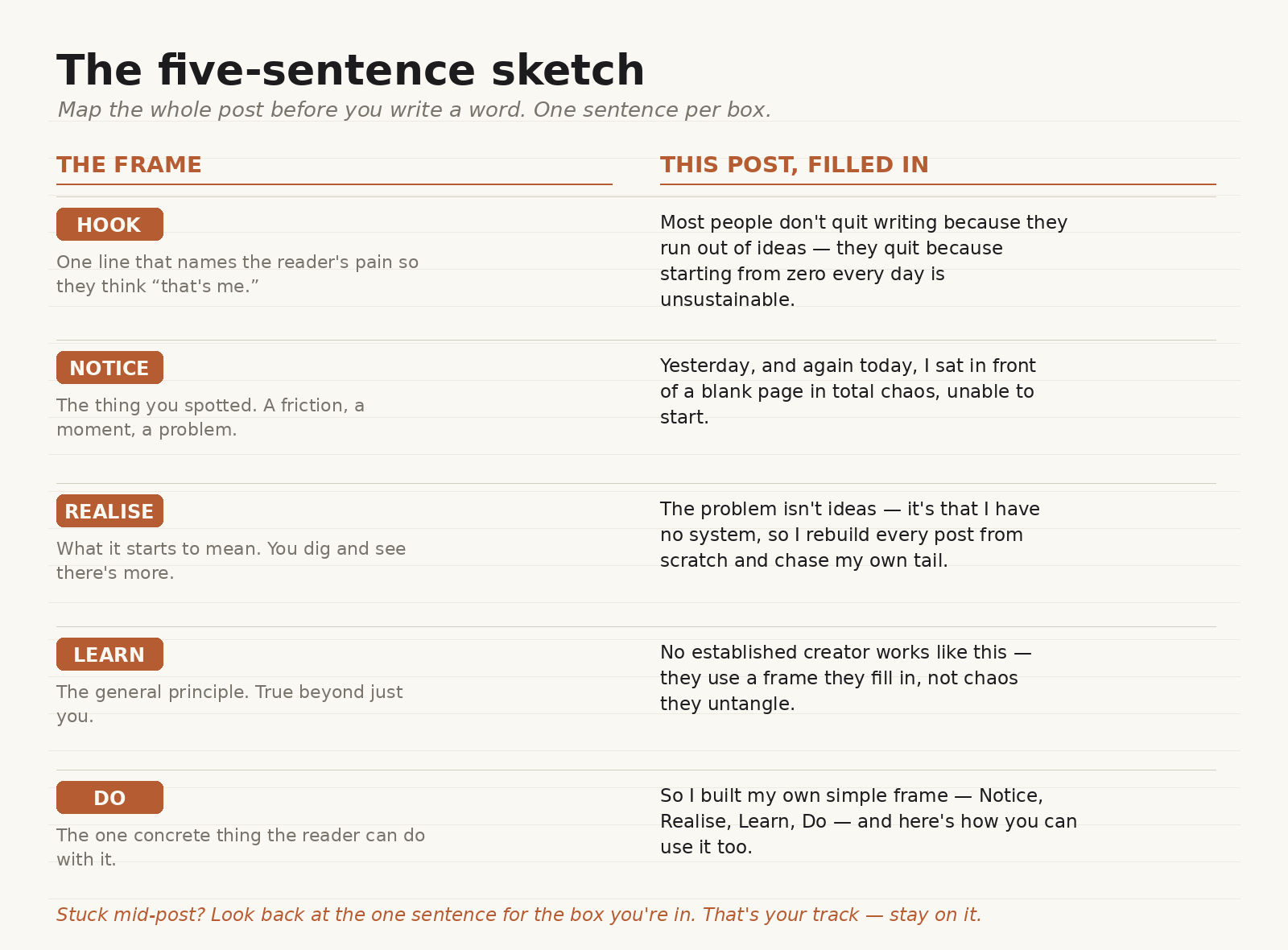
And here’s the power move—if you want to speed up your brainstorming, sharpen your arguments, or find an angle you couldn’t quite see on your own.
Take the template, upload it to Claude or ChatGPT, and tell it about this post. Then give it the one thing you noticed today and ask it to walk that idea through the frame with you—notice, realise, learn, do. Let it help you dig.
Take it easy and do your thing,
Jack
Footnotes
George Loewenstein, “The Psychology of Curiosity: A Review and Reinterpretation,” Psychological Bulletin, 1994 — the information-gap theory of curiosity. https://www.cmu.edu/dietrich/sds/docs/golman/golman_loewenstein_curiosity.pdf
Matthias J. Gruber, Bernard D. Gelman & Charan Ranganath, “States of Curiosity Modulate Hippocampus-Dependent Learning via the Dopaminergic Circuit,” Neuron, 2014 (UC Davis). https://www.cell.com/neuron/fulltext/S0896-6273(14)00804-6