

How to never run out of things to write
#5: Your first thought of the day is already an idea—here's how to question it into an article.


If you’re a beginner writer, a substacker, or a blogger, one of your biggest problems is clarity. You don’t know what to write about, who it is for, and why anyone should care.
If you pair it with perfectionism, procrastination, and you sprinkle on top some impostor syndrome, you get a perfect recipe for giving up.
Today, I want to show you a very simple way of coming up with ideas for articles, which I discovered by accident on day 5 of my writing practice. And you know what? My brain actually handed me the idea this morning.
If you want an easy way to come up with ideas and never run out, this might be for you.
It started with a thought I couldn’t switch off
I’ve committed to a little writing experiment: 100 articles in 100 days. On days 3 and 4, I noticed the question “What am I going to write about?” had become the first thought of the day. Literally, my brain handed it over the moment I opened my eyes.
It was usually paired with two or three other thoughts, like dad and Father’s Day, and then I had an idea: why not connect them and write about that?
So I wrote the ideas down and looked for something useful for a reader, and that’s how I got “How Do You See Your Dad?” and “Dear Substack, Meet My Dad”—the articles on days three and four.
Today is day 5, and I had a similar story. First thought after waking up: writing and Substack. Same pattern. So I started to question and think: is this normal? Am I turning this Substack into some unhealthy obsession? Why is this the first thing in my head every morning?
So I had a heart-to-heart with Claude to get to the bottom of it, and what I learned turned into a system for coming up with ideas and never running out again.
I’m writing this to systematise the process and solve my own problem as a beginner writer—a solution my own brain handed me in the morning. First, I need to explain how our brains wake up.
How your brain wakes up
Sleep inertia
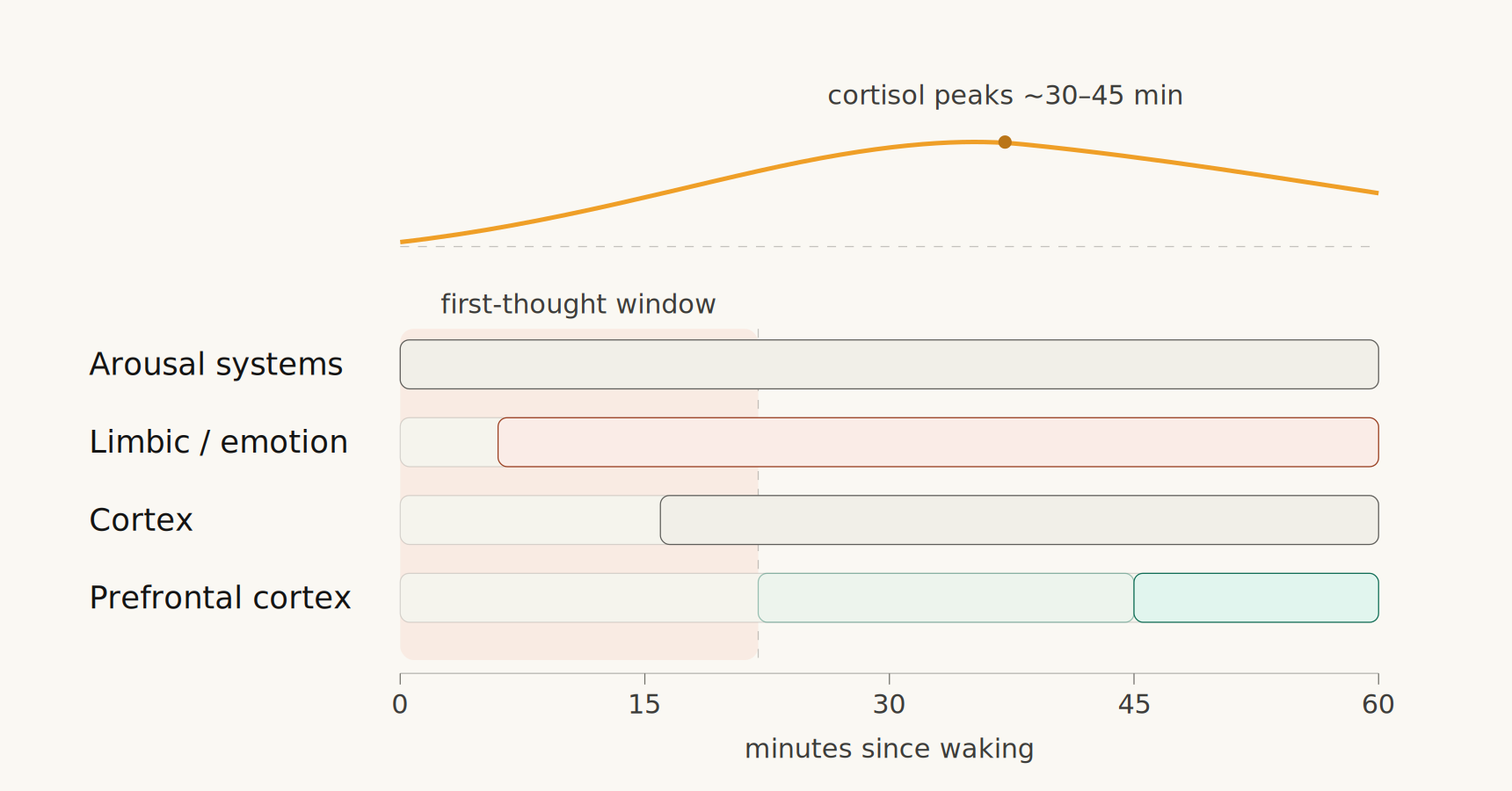
To me, it’s mind-blowing that our brains don’t just switch on in the morning. It’s a process—they boot up in segments, like our computers. The grogginess lifts in fifteen to thirty minutes, but all systems running takes about an hour, depending on your sleep phase and how rested you are. I’m simplifying, but that’s the shape of it.
We wake up in stages. Here’s the sequence.
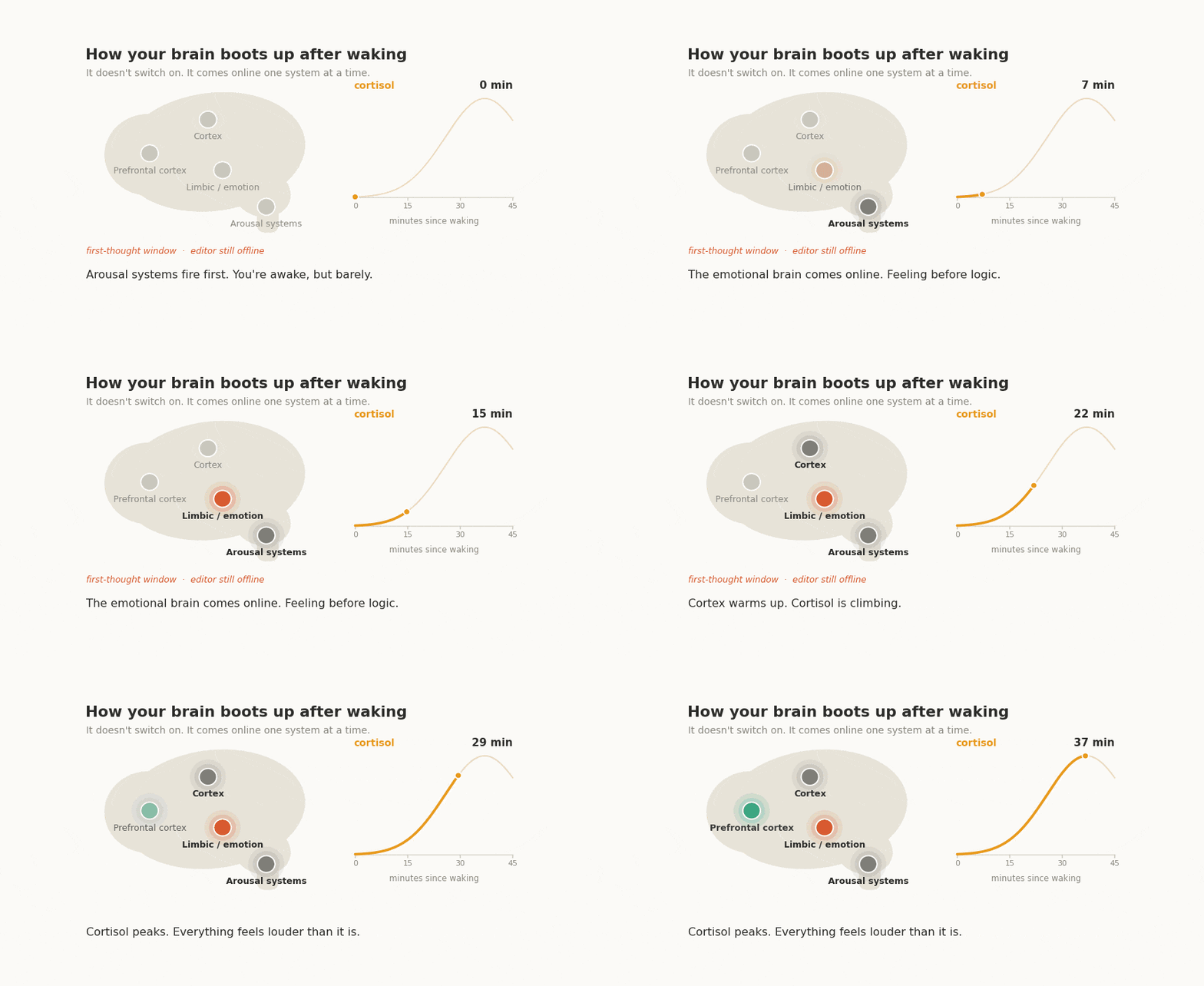
Your brain wakes up in four stages, in this order:
1. Brainstem arousal—the ignition.
This is the base layer. Basic wakefulness, alertness, heart rate, breathing. It fires first because everything else needs it running underneath. Think of it as the power button and the cooling fan spinning up.
2. The emotional and memory centres—the limbic system.
This is where feeling and memory come online:
The amygdala, which tags things by emotional weight: threat, importance, what matters.
The hippocampus, which handles memory.
These wake up while the editor is still asleep. And here’s the kicker: the part of your brain that weighs things by feeling is awake before the part that reasons about them. So the thought you’re handed in the morning isn’t the most important one. It’s the one with the most emotional charge.
3. The broader cortex—the world comes into focus.
Sensory processing kicks in, the world sharpens, and your thoughts start forming into something more than fog.
4. The prefrontal cortex—the editor, last to arrive.
This is the planner, the filter, the part that says “this isn’t actually worth worrying about.” It’s the one with the hardest evidence behind its lag, and it’s the hero of this whole story. Right after you open your eyes, it’s still offline. You’re running an emotional brain with no supervisor.
Running underneath all of it: cortisol. The cortisol awakening response is a sharp rise in the first 30 to 45 minutes after waking. It’s normal and useful — cortisol mobilises energy for the day. But it also amplifies the emotional weight of whatever you’re focused on. The same thought feels manageable at noon. At 5am, editor offline and cortisol climbing, it can feel very heavy.
So my morning thoughts — “What am I writing today? Dad, Father’s Day” — arrive in the window where the emotional and memory centres are up but the editor is down. The limbic phase, before the prefrontal cortex has booted.
The amygdala is tagging by emotional weight, the hippocampus pulling up memories. What surfaces is charged and personal. And because the editor isn’t at his desk yet, nothing filters it, softens it, or talks you out of it. You get the raw version. That’s why the morning thought is more honest than the noon one.
The open loop
Bluma Zeigarnik, a psychologist in the 1920s, noticed that waiters could remember unpaid orders in detail but forgot them the moment the bill was settled.
She tested it and found the mind holds unfinished tasks in a state of low tension, keeping them active until they close.
Finished tasks get filed and released. Open ones keep pinging. A daily writing commitment, which by definition never closes, became my permanent open loop. That’s why my brain keeps surfacing it every morning.
You’ll recognise your own open loops by watching your thoughts. Keep a notebook by the bed, or record them into your phone with something like Wispr Flow. Here’s a list to get you started:
an argument never resolved
a text or email you should have replied to
a bill, or a debt that grows every month
the side project, the book, the garage you half-built
a difficult conversation you keep avoiding
a medical result you’re waiting on
a decision you keep postponing—the job, the move, the relationship
a worry about a child, or a parent getting older
a cliffhanger in a series you can’t stop thinking about
a GTA mission you couldn’t finish on the Xbox
Put the two together
Every morning, sleep inertia delivers raw, unedited, emotional thoughts. Zeigarnik decides which one surfaces—the most charged open loop. Stack them and you get a daily readout of what matters to you most, served right before you can talk yourself out of it.
The writing loop is why writing shows up for me—it’s my unfinished thing. Your other loops—debt, grief, kids—are your subjects.
The loop is the fuel, not always the topic.
And the morning brain generates—it doesn’t edit. Catch the thoughts raw now, shape them later. Most beginners fail because they ask a half-booted brain to finish a polished piece on the spot.
One thing this is not: it’s not journaling for its own sake. Morning pages drain the clutter out of your head and get thrown away. This does the opposite—it mines that same raw morning material for something you actually ship.
You just write the thoughts into a list, then start the process I call drilling down—finding the connections and working out how to turn them into something useful for a reader.
The example—how I drilled one morning thought
Friday evening, at 40 years old, I took my son to Currys and bought an Xbox, GTA 5, and Battlefield 2. I went back to one of the things I loved when I was younger: playing games. The next day, Saturday, I spent three or four hours on GTA, having fun like a kid. I loved it.
Then I had a FaceTime call with my sister. I shared my excitement about the Xbox. She said: “Aren’t you too old for Xbox? I don’t know anyone your age who plays. You’re already 40.” That stung. It made me think—am I having some midlife crisis, buying an Xbox at 40?
But I loved playing. It was refreshing—the last time I’d played GTA 5 was on my first Xbox, the one I bought at 23, when I moved to the UK and started university.
The next morning, the first thoughts that surfaced were: GTA, Xbox, and—as usual—writing. Three loops.
GTA: I had open missions, wondering whether to play.
The nagging question about the Xbox purchase.
Writing on Substack.
I wrote down three tags: Xbox, GTA mission, writing—plus the fact that I’m 40. Now, how do you drill down? You go to Claude, like I did, and tell it the story: “I had three thoughts resurface the moment I woke up—GTA, Xbox, open missions, writing. Help me work out why.” You give the background only you have. Why did I buy the Xbox? What’s underneath it? Then you let it ask questions, and you drill until you hit something useful—or uncomfortable—for a reader.
[H3: The questions that drill it down]
Here’s a list of questions that will help you go through the drill-down process.
1. Surface it—get the bare thing onto the table.
These pull the raw thought out before you start judging it.
What was the thought? Just name it.
What’s the feeling attached to it?
When did it start? What happened just before?
What’s the story behind it? (This is the one only you can answer — give the background.)
2. Find the charge—locate where it actually hurts or pulls.
The charge is the signal. These find it.
Why did this stick with me?
Why did it sting / excite / unsettle me?
What part of this can’t I let go of?
If I’m honest, what’s the bit I don’t want to look at?
3. Drill down—go under the surface thought.
This is the core move. You keep asking until you hit something that isn’t just about you.
What’s underneath this?
Why does that matter? (Then ask it again of the answer. And again.)
What am I really reacting to here?
What belief is sitting under this? Who decided that belief? Is it even true?
What’s the thing I’m assuming without questioning it?
4. Widen it—turn private into shared.
This is the turn. These questions test whether it’s an article or just a diary entry.
Is this only about me, or do other people feel it too?
Who else has this exact problem and doesn’t have words for it?
What’s the general principle hiding inside my specific story?
So what? Why should a stranger care?
What could someone do differently after reading this?
5. Pressure-test—make sure it’s true and useful.
Before you write, check it holds.
Is this actually true, or does it just sound good?
What’s the strongest argument against it?
What’s the one sentence a reader should walk away with?
[H3: Watch it turn]
So I did exactly that. I gave Claude the three tags and the story, and we started drilling. Here’s roughly how it went.
Why did my sister’s comment sting? Because a part of me wondered if she was right.
Why would she be right? Because somewhere I’d absorbed the idea that a 40-year-old man playing Xbox is a bit sad. A bit stunted.
Where did that idea come from? Who decided 40 is too old to play? Nobody decided it. It’s just in the water. We’re told that past a certain age, play is something you supervise your kids doing, not something you’re allowed to do yourself.
So what is this actually about—is it about Xbox? No. It’s not about Xbox at all. It’s about permission. About the quiet shame we’re taught to attach to play once we’re “grown up.” And about what we lose when we hand all our fun to our children and keep none for ourselves.
And there it was. That’s the turn—the moment it stopped being my story about a console and became everyone’s story about growing up and forgetting how to play. “I bought an Xbox at 40” is a diary entry. Nobody cares. “Why do we feel ashamed of play in midlife?” is an article—because a lot of 40-year-olds feel exactly that and have never put words to it.
That’s the whole move. You take the private thing and drill until it becomes a shared thing. The moment it turns, you’ve got your piece.
A quick word of caution before you run off and do this. Not every charged thought belongs on the internet. Some are too raw, and some involve other people who didn’t agree to be in your writing.
Part of the skill is knowing which loops to drill in public and which to keep in the notebook. Charge is the signal that something’s there—it’s not automatically permission to publish.
The system, start to finish
Here’s the whole thing in one place, so you can use it tomorrow morning:
1. Before you touch your phone, catch the tags. The first one or two charged thoughts. Don’t develop them. Just name them.
2. Capture them raw. Notebook by the bed, or speak them into your phone with something like Wispr Flow. Do it before the editor wakes up and tidies them away.
3. Bring them to Claude with the background only you have. The thought is the seed. The story behind it is yours alone—give it.
4. Let it ask why. You answer. “Why does that matter?”—asked again and again of each answer—is the question that does most of the work.
5. Drill until something turns. Keep going until the private thing becomes a shared thing. That turn is your article. If it won’t turn, bin it. There’s another one tomorrow.
6. Generate now, edit later. Get the messy draft down in the morning state. Shape it when the editor’s back at his desk. Two brains, two jobs.
And this is why you never run out. Your loops refill overnight, every night, for free. There’s no morning without at least one charged thought waiting for you. You’re not hunting for ideas anymore—you’re catching what your own brain hands you, and drilling until it turns into something a stranger can use.
This article you’re reading? It came from exactly this. Day 5. Three tags: Xbox, GTA, writing. One morning, one drill. That’s it.
So tomorrow—before the phone, before the day floods in—catch the tag. See what your brain hands you.
Take it easy and do your thing,
Jack
Oh, you’re most welcome and thank you for your comment. Let me know how it went - and let’s help each other out by exchanging experiences. Maybe you notice something that I have overlooked. Always nice to brainstorm. Good luck!
This was an intriguing article. The idea seems good to try. I will try it tomorrow morning. Thank you for this idea.